
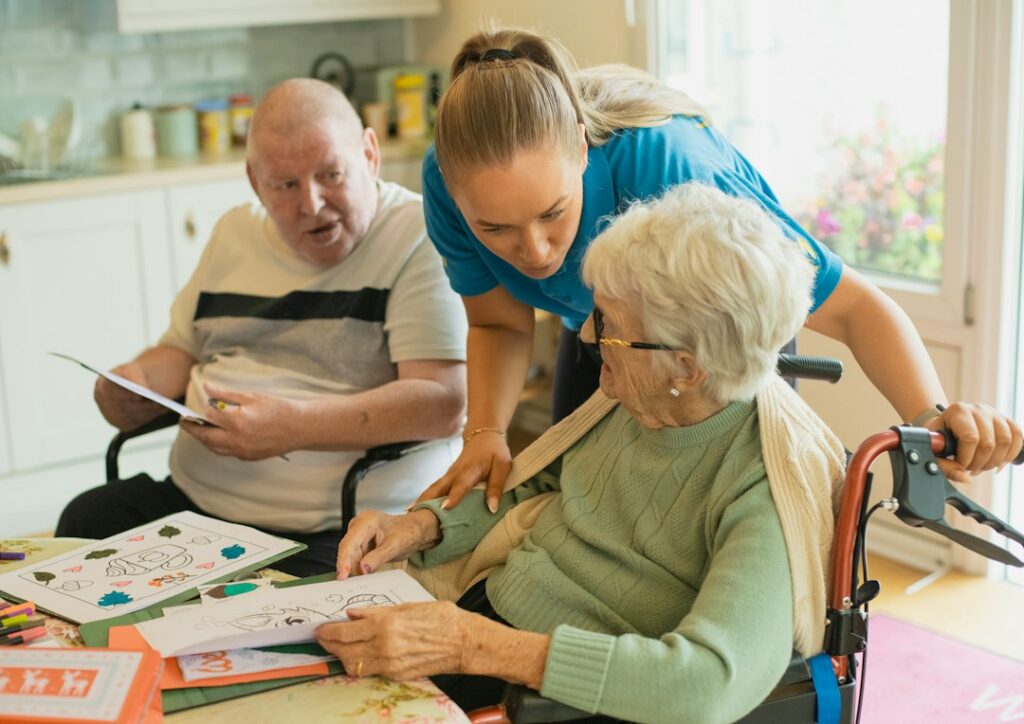
What are intergenerational activities?
Intergenerational activities bring older adults and younger people together for purposeful interaction, conversation, learning, or play. In an assisted living setting, these activities may involve children, teenagers, college students, families, or community volunteers.
The goal is not simply to keep residents busy. Well-designed activities create meaningful opportunities for residents to share experiences, develop relationships, and remain connected with the wider community. Younger participants also benefit by gaining patience, perspective, practical knowledge, and a better understanding of aging.
Examples may include:
- Reading groups with children
- Art, music, or craft projects
- Shared gardening or indoor plant care
- Oral history conversations
- Board games and puzzles
- Holiday decorating
- Technology help sessions
- Cooking demonstrations using family recipes
- Letter-writing or story-sharing projects
- School or youth-group visits
Activities can be scheduled regularly or arranged for special occasions. The most successful programs usually provide a clear purpose rather than relying on unstructured visits.
How do these activities benefit assisted living residents?
Intergenerational programs can support emotional well-being, cognitive engagement, physical activity, and a stronger sense of belonging. The effect depends on the resident’s interests, abilities, and comfort level, but even brief interactions can be meaningful.
Many residents appreciate having a role beyond that of a care recipient. A resident who teaches a simple craft, explains a family tradition, reads aloud, or shares knowledge about past events may feel useful and respected. This sense of contribution can be especially valuable after retirement, relocation, or a major change in household routines.
Regular contact with younger people may also reduce feelings of isolation. A visit gives residents something to anticipate, while a continuing relationship can provide familiarity and emotional connection. This is different from a large social event where residents may not have enough time to speak with individual visitors.
Cognitive benefits may come from conversation, recalling personal experiences, learning new skills, and adapting to different communication styles. These interactions are not a treatment for memory-related conditions, but they may provide enjoyable mental stimulation.
Physical activity can be included in gentle ways. Residents might pass a ball, water plants, move to music, arrange materials on a table, or participate in a supervised movement session. The activity should match residents’ mobility and endurance rather than emphasize performance.
Why do younger participants benefit?
Intergenerational activities can help children and young adults develop a more realistic understanding of older adulthood. Instead of viewing aging only through the lens of illness or dependence, participants see older people as individuals with interests, humor, skills, memories, and opinions.
A resident may explain how household life worked before widespread internet access, describe a former occupation, teach a traditional game, or discuss a meaningful historical event. These conversations can turn abstract lessons into personal stories.
Younger participants may also practice:
- Listening and asking respectful questions
- Speaking clearly and patiently
- Cooperating with people of different abilities
- Understanding that communication may take more time
- Recognizing common interests across age groups
- Showing flexibility when plans change
For children, the experience can support empathy and confidence. For teenagers, it may encourage leadership and responsibility. For families, shared visits can help children become more comfortable around older relatives and neighbors.
What activities work well for different abilities?
Activities should offer more than one way to participate. A resident who cannot stand for long periods may still choose colors, tell a story, sing, sort materials, or encourage others. Designing activities around flexible roles helps prevent residents with mobility, hearing, vision, or memory challenges from being left out.
Music is often adaptable because residents can sing, listen, tap along, request familiar songs, or discuss memories connected to music. Art projects can be simplified by using larger materials, easy-grip tools, or pre-prepared pieces.
Story-based activities may include a question of the day, a themed discussion, or a display of old household objects. Residents do not need to remember every detail perfectly to participate. The focus should be conversation, not testing memory.
Games can be modified by reducing the number of rules, using large-print materials, allowing extra time, or creating team-based play. The activity should remain enjoyable even if someone does not keep score or complete every step.
How can assisted living communities make visits comfortable?

A successful program requires planning around safety, sensory needs, transportation, schedules, and resident preferences. Assisted living staff should know who is visiting, how many people are expected, and what activities will take place.
Small groups are often easier to manage than crowded gatherings. A quieter room may work better for residents who become overwhelmed by noise. Seating should allow residents and visitors to face one another, and pathways should remain clear for walkers and wheelchairs.
Visits may be affected by seasonal conditions in Level Green, including winter weather, slippery outdoor surfaces, heat, or heavy rain. Indoor alternatives are useful when travel or outdoor activities are uncomfortable. Window visits, recorded messages, video conversations, and shared projects delivered in advance can help maintain connection when in-person gatherings are not practical.
Health precautions may also be needed during periods of respiratory illness. Hand hygiene, staying home when sick, and following the community’s current visitation policies help protect residents and visitors.
What should families ask before arranging an intergenerational activity?
Families can ask how the activity will be supervised, what accommodations are available, and whether residents may opt out. Participation should be voluntary for both residents and younger visitors.
Useful questions include:
- Is the activity appropriate for the resident’s mobility and communication needs?
- Will there be a quiet option if the resident becomes tired?
- Can the visit include a familiar object, photograph, recipe, or song?
- Are children prepared to speak slowly and listen respectfully?
- How will privacy be protected if photographs are taken?
- What should visitors do if a resident becomes confused or upset?
- Is there an indoor plan for poor weather?
A resident may enjoy younger visitors one day and prefer rest on another day. Fatigue, pain, medication effects, hearing difficulty, or changes in mood can affect participation. A flexible approach respects the resident’s choices.
Common misconceptions about intergenerational programs
One misconception is that any visit automatically creates a meaningful connection. In practice, the quality of the interaction matters more than the number of visitors. A small group with a shared activity may be more beneficial than a large, noisy event.
Another misconception is that residents must entertain children. Intergenerational activities should be reciprocal. Younger participants can teach, create, listen, and contribute rather than expecting residents to perform or tell stories on demand.
It is also inaccurate to assume that all older adults enjoy working with children. Some residents may prefer interaction with teenagers, young adults, families, or volunteers with shared interests. Personal choice should guide participation.
Finally, intergenerational activities are not limited to special holidays. Regular, predictable contact can be more valuable than occasional celebrations because relationships have time to develop.
How can families support meaningful connections?
Families can help by identifying the resident’s interests, preparing visitors for the resident’s communication style, and choosing activities that encourage conversation without pressure. Bringing a familiar recipe, photograph, craft, book, or piece of music may provide an easy starting point.
The most useful visits often involve simple shared tasks: sorting photographs, decorating cookies, tending plants, completing a puzzle, or listening to stories. These activities create natural conversation and allow residents to participate at their own pace.
For assisted living residents in Level Green, regular intergenerational contact can provide continuity between the residence, family life, and the surrounding community. The value comes from respectful attention, shared purpose, and the opportunity for people of different ages to recognize what they have in common.
